your originating ip address

Tuesday

‘I want to learn Artificial Intelligence and Machine Learning. Where can I start?’


@mrdbourke on Instagram, Photo by Madison Kanna
I was working at the Apple Store and I wanted a change. To start building the tech I was servicing.
I began looking into Machine Learning (ML) and Artificial Intelligence (AI).
There’s so much going on in the field.
Every week it seems like Google or Facebook are releasing a new kind of AI to make things faster or improve our experience.
And don’t get me started on the number of self-driving car companies. This is a good thing though. I’m not a fan of driving and roads are dangerous.
Even with all this happening, there’s still yet to be an agreed definition of what exactly artificial intelligence is.
Some argue deep learning can be considered AI, others will say it’s not AI unless it passes the Turing Test.
This lack of definition really stunted my progress in the beginning. It was hard to learn something which had so many different definitions.
Enough with the definitions.

How did I get started?

My friends and I were building a web startup. It failed. We gave up due to a lack of meaning. But along the way, I was starting to hearing more and more about ML and AI.
“The computer learns the things for you?” I couldn’t believe it.
I stumbled across Udacity’s Deep Learning Nanodegree. A fun character called Siraj Raval was in one of the promo videos. His energy was contagious. Despite not meeting the basic requirements (I had never written a line of Python before), I signed up.
Three weeks before the course start date I emailed Udacity support asking what the refund policy was. I was scared I wouldn’t be able to complete the course.
I didn’t get a refund. I completed the course within the designated timeline. It was hard. Really hard at times. My first two projects were handed in four days late. But the excitement of being involved in one of the most important technologies in the world drove me forward.
Finishing the Deep Learning Nanodegree, I had guaranteed acceptance into either Udacity’s AI Nanodegree, Self-Driving Car Nanodegree or Robotics Nanodegree. All great options.
I was a little lost. “Where do I go next?”
I needed a curriculum. I’d built a little foundation with the Deep Learning Nanodegree, now it was time to figure out where I’d head next.

My Self-Created AI Masters Degree

I didn’t plan on going back to university anytime soon. I didn’t have $100,000 for a proper Masters Degree anyway.
So I did what I did in the beginning. Asked my mentor, Google, for help.
I’d jumped into deep learning without any prior knowledge of the field. Instead of climbing to the tip of the AI iceberg, a helicopter had dropped me off on the top.
After researching a bunch of courses, I put a list of which ones interested me the most in Trello.
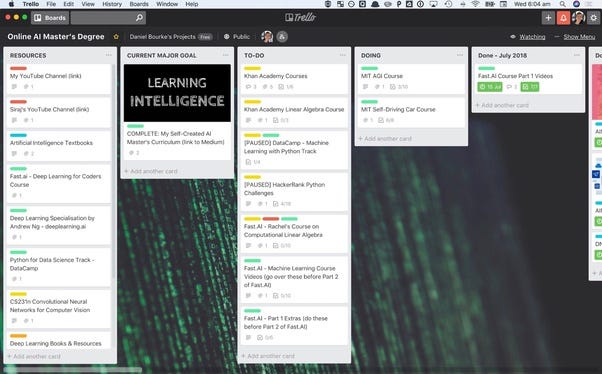
Trello is my personal assistant/course coordinator.
I knew online courses had a high drop out rate. I wasn’t going to let myself be a part of this number. I had a mission.
To make myself accountable, I started sharing my learning journey online. I figured I could practice communicating what I learned plus find other people who were interested in the same things I was. My friends still think I’m an alien when I go on one of my AI escapades.
I made the Trello board public and wrote a blog post about my endeavours.
The curriculum has changed slightly since I first wrote it but it’s still relevant and I visit the Trello board multiple times per week to track my progress.

Getting a job

I bought a plane ticket to the US with no return flight. I’d been studying for a year and I figured it was about time I started putting my skills into practice.
My plan was to rock up to the US and get hired.
Then Ashlee messaged me on LinkedIn, “Hey I’ve seen your posts and they’re really cool, I think you should meet Mike.”
I met Mike.
I told him my story of learning online, how I loved healthtech and my plans to go to the US.
“You may be better off staying here a year or so and seeing what you can find, I’ think you’d love to meet Cameron.”
I met Cameron.
We had a similar chat what Mike and I talked about. Health, tech, online learning, US.
“We’re working on some health problems, why don’t you come in on Thursday?”
Thursday came. I was nervous. But someone once told me being nervous is the same as being excited. I flipped to being excited.
I spent the day meeting the Max Kelsen team and the problems they were working on.
Two Thursday’s later, Nick, the CEO, Athon, lead machine learning engineer, and I went for coffee.
“How would you like to join the team?” Asked Nick.
“Sure.” I said.
So it turns out, my US flight got pushed back a couple months and now I’ve got a return ticket.

Sharing your work

Learning online, I knew it was unconventional. All the roles I’d gone to apply for had Masters Degree requirements or at least some kind of technical degree.
I didn’t have either of these. But I did have the skills I’d gathered from a plethora of online courses.
Along the way, I was sharing my work online. My GitHub contained all the projects I’d done, my LinkedIn was stacked out and I’d practiced communicating what I learned through YouTube and articles on Medium.
I never handed in a resume for Max Kelsen. “We checked you out on LinkedIn.”
My body of work was my resume.
Regardless if you’re learning online or through a Masters Degree, having a portfolio of what you’ve worked on is a great way to build skin in the game.
ML and AI skills are in demand but that doesn’t mean you don’t have to showcase them. Even the best product won’t sell without any shelf space.
Whether it be GitHub, Kaggle, LinkedIn or a blog, have somewhere where people can find you. Plus, having your own corner of the internet is great fun.

How do you start?

Where do you go to learn these skills? What courses are the best?
There’s no best answer. Everyone’s path will be different. Some people learn better with books, others learn better through videos.
What’s more important than how you start is why you start.
Start with why.
  • Why do you want to learn these skills?
  • Do you want to make money?
  • Do you want to build things?
  • Do you want to make a difference?
Again, no right reason. All are valid in their own way.
Start with why because having a why is more important than how. Having a why means when it gets hard and it will get hard, you’ve got something to turn to. Something to remind you why you started.
Got a why? Good. Time for some hard skills.
I can only recommend what I’ve tried.
I’ve completed courses from (in order):
  • Treehouse — Introduction to Python
  • Udacity — Deep Learning & AI Nanodegree
  • Coursera — Deep Learning by Andrew Ng
  • fast.ai — Part 1, soon to be Part 2
They’re all world class. I’m a visual learner. I learn better seeing things being done/explained to me on. So all of these courses reflect that.
If you’re an absolute beginner, start with some introductory Python courses and when you’re a bit more confident, move into data science, machine learning and AI.

How much math?

The highest level of math education I’ve had was in high school. The rest I’ve learned through Khan Academy as I’ve needed it.
There are many different opinions on how much math you need to know to get into machine learning and AI. I’ll share mine.
If you want to apply machine learning and AI techniques to a problem, you don’t necessarily need an in-depth understanding of the math to get a good result. Libraries such as TensorFlow and PyTorch allow someone with a bit of Python experience to build state of the art models whilst the math is taken care of behind the scenes.
If you’re looking to get deep into machine learning and AI research, through means of a PhD program or something similar, having an in-depth knowledge of the math is paramount.
In my case, I’m not looking to dive deep into the math and improve an algorithm’s performance by 10%. I’ll leave that to people smarter than me.
Instead, I’m more than happy to use the libraries available to me and manipulate them to help solve problems as I see fit.

What does a machine learning engineer actually do?

What a machine engineer does in practice might not be what you think.
Despite the cover photos of many online articles, it doesn’t always involve working with robots that have red eyes.
Here are a few questions an ML engineer has to ask themselves daily.
  • Context — How can ML be used to help learn more about your problem?
  • Data — Do you need more data? What form does it need to be in? What do you do when data is missing?
  • Modeling — Which model should you use? Does it work too well on the data (overfitting)? Or why doesn’t it work very well (underfitting)?
  • Production — How can you take your model to production? Should it be an online model or should it be updated at time intervals?
  • Ongoing — What happens if your model breaks? How do you improve it with more data? Is there a better way of doing things?
I borrowed these from a great article by Rachel Thomas, one of the co-founders of fast.ai, she goes into more depth in the full text.
For more, I made a video of what we usually get up to on Monday’s at Max Kelsen.

No set path

There’s no right or wrong way to get into ML or AI.
The beautiful thing about this field is we have access to some of the best technologies in the world, all we’ve got to do is learn how to use them.
You could begin by learning Python code.
You could begin by studying calculus and statistics.
You could begin by learning about the philosophy of decision making.
Machine learning and AI fascinates me because of this intersection of fields.
The more I learn about it, the more I realise there’s plenty more to learn. And this hypes me up.
Sometimes I get frustrated when my code doesn’t run. Or I don’t understand a concept. So I give up temporarily. I give up by letting myself walk away from the problem and take a nap. Or go for a walk. When I come back it feels like I’m looking at it with different eyes. The excitement comes back. I keep learning.
There’s so much happening in the field it can be daunting to get started. Too many options lead to no options. Ignore this.
Start wherever interests you most and follow it. If it leads to a dead end, great, you’ve figured out what you’re not interested in. Retrace your steps and take the other fork in the road instead.
Computers are smart but they still can’t learn on their own. They need your help.

PS if you want have any questions, feel free to reach out to me anytime at mrdbourke.com.
*This article originally appeared as an answer by Daniel Bourke on Quora.

https://hackernoon.com/i-want-to-learn-artificial-intelligence-and-machine-learning-where-can-i-start-7a392a3086ec

Friday

Fun idea - Mastery of Taking Minutes

Thanks for the great ideas in our discussions. 
Based on some of the wildly successful corporate consultations that we offer, 
here's a fast and easy idea for you to practice your minute taking / note taking skills.
  1. Select one of your favorite TV or Youtube non-fiction programs 
    (e.g.home improvement show, documentary, cooking, etc.)
    Practice Minute Taking while watching non-fiction TV / Youtube
  2. Using your preferred minute taking style (e.g. pen and paper, smartphone, or laptop.),take notes on the program for up to an hour's duration.
    1. Remember, your minutes ought to be a summary of what was discussed or decided;
      minutes are not a word-for-word transcription.
    2. Thus a half-hour of notes might only have 3-7 bullets,
      an hour of notes might yield 5-15 bullets.
  3. Later, after the program is over, 
    read-back your notes to yourself in an audio recording,
    or try explaining the program to a friend.
    Do your notes make sense?
  4. Type-up your minutes into a minutes template (found online or from your workplace),
    summarizing the discussions and decisions made on the program.
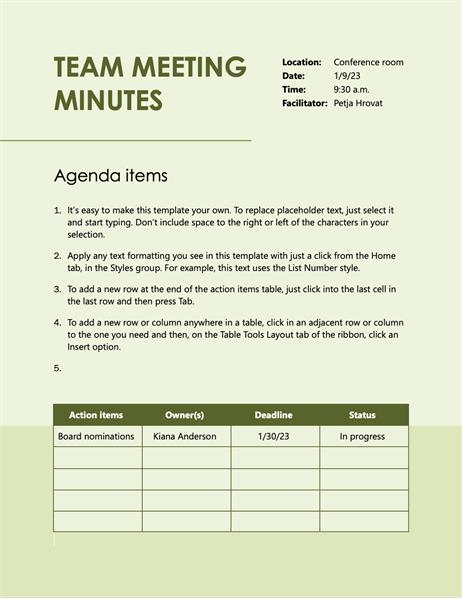
    Minutes Template
  5. Email the completed minutes template to another friend for 'Approval.'
    Do they understand your minutes, or are edits needed before 'Approval'?
Enjoy the minute-taking practice and let us know how it goes!
P.S. I highly recommend one of those home improvement programs:
  • they encounter problems, 
  • discuss the possibilities for resolution, 
  • and then make decisions on how to proceed.

Monday

Conversation is a skill. Here’s how to be better at it


https://www.theladders.com/career-advice/conversation-is-a-skill-heres-how-to-be-better-at-it

Panio: Conversation is a skill, and one we are actually quite bad at.
Celeste: Yes, naturally. Knowing how to have a good conversation is not information that you can just memorize and then you’re done. As a skill, you have to practice it. You don’t go to the gym [just] once. It’s the same thing with conversation.

Panio: I experience it every day because I have eight-year-old twins. One will talk in this ear and one will talk in the other ear about totally unrelated topics, and they won’t even pause for each other.
One of the things that I thought was really intriguing [in We Need to Talk] was conversational narcissism. Maybe I just did it by bringing up the anecdote about my kids, but it’s when someone talks about something, and your [conversation] partner immediately brings up something personal or relative to them.
Celeste: Conversational narcissism is a scary term for something that just happens constantly, and the way that the researchers talk about it is a shift response or a support response. Either I can shift the attention to myself, or I can support what it is that you’re talking about.
Panio: What would a shift example be?
Celeste: If you were to say, “I have eight-year-old twins and they talk in my ear all the time,” and I would say, “God, I know what you mean. My son talks to me — ” and we start talking about my kid. As opposed to, “I have a kid, too. What is that like [for you]?” I’m bringing something up, but it’s in support of what you’re saying.
Celeste: Exactly. A conversational narcissist is the one that keeps taking the ball from the game of catch and not ever passing it back.
“Just listening to somebody is an act of love.”
Panio: Yeah. I had a fear while reading your book: “Am I doing these things? Do I have these conversational bad habits, and I’m just unaware of them?” What’s a way that I could find out? Day-to-day, your friends don’t give you feedback and say, “You know, you talk way too much about yourself.”
Celeste: Right. Or they do—when they’re ready to not be friends with you anymore.
There’s this great exercise, and it’s inspired by Pat Wagner, an expert on conversation. Make a list of the five things that people do in a conversation that annoy you the most. Maybe “interrupt you all the time,” maybe “only give yes or no answers,” whatever they are. Five things that are most annoying to you.
Then go to the people closest to you. Do not tell them what the list is. Just say, “Okay, how many of these things do I do when I’m in conversation with you?” You will usually discover that many of the things that annoy you the most when other people do them are things that you are doing.
That’s partly because a conversation, at its worst, is a power struggle.
Panio: What do you mean by that? Someone is trying to dominate the other person?
Celeste: Exactly. It’s part of that conversational narcissism. It’s this pull of attention, this tug of war. If you’re constantly trying to win that tug of war, and someone else is tugging back, that’s irritating. But that means that they’re doing what you’re doing, and that’s probably the most annoying thing you can think of.
Celeste: Yeah. I started this whole thing to learn how to be a better interviewer. Then I discovered that those exact same skills, the things that worked in the studio, worked just as well with my kid and my spouse and my boss and everybody else in my life. The essential components of what makes a good conversation are basically universal.
Panio: I don’t know if you use this word, but it seems like the implication is authenticity. People can smell it if you’re not being sincere. They just check out.
Celeste: Exactly. Kids know when you’re BS-ing them. They aren’t subtle about it at all — they’ll immediately point it out. As adults, we just get better at hiding that we’ve discovered someone is BS-ing us.
Human beings have a BS detector. We know when somebody doesn’t actually like us. We know when someone’s distracted and doesn’t want to sit there and talk to us. Look, if you don’t want to talk to somebody, just walk away. Excuse yourself and walk away.
Panio: I like having conversations, but as a pretty introverted guy, I certainly have those moments where I’m fried and tired, and I’m just like, “I can’t do this.” How do you extricate yourself with tact? Is it enough to say, “I’m so sorry, I’m just really tired. Do you mind if we talk later?”
Celeste: Yeah, absolutely. I do it all the time. I have adult ADD, so I’m constantly saying to people, “My brain is in a million places. I’m having trouble focusing. I want to hear what you’re saying, and I can’t right now. Give me a rain check, and I’ll come back to you when my brain is functioning.” I say some version of that pretty much all the time.
Or my son will come and tell me about another new video game. I’ll be like, “Dude, I can’t absorb anything you’re telling me, but I will sit here and listen if that’s what you need from me.”
That’s one of the things I try to get through in the book — just listening to somebody is an act of love. That’s a gift. We always feel like we need to prove how smart we are, or prove how much we know, and interject what we think and give advice to other people. Sometimes the best thing you can do for that person is just listen to them. You don’t actually need to say anything at all. You can just listen.
Panio: I was really moved [when] you wrote about your friend. Her father passed away, and she was, of course, devastated. Then you weighed in about your experience losing your father. You thought you were empathizing and being a good friend, but she got really annoyed with you.
Celeste: She got angry, yeah. She said, “You win. Fine.”
Panio: Like, “Your pain is worse.”
Celeste: Exactly. For quite a while I kept thinking, “Well, she didn’t understand. I was just trying to be helpful.” I was just trying to say, “I know how you feel.”
[But] she was right. I was interjecting my story of my own struggle, when it just needed to be about her. She needed me to bear witness to the kind of man her father was. That’s all she needed.
“If you don’t know what to say, it’s an indication that you need to learn something.”
Panio: I thought you had a really astute insight — you said you were uncomfortable by her feelings or what she was expressing. I think a lot of us are. If a friend comes to us, and they’re really hurt —
Celeste: You don’t know what to say.
Panio: You don’t want to say the wrong thing. You don’t want to distract them, because that seems unfeeling. [So] everyone says, “I’ll share a moment of vulnerability for me. I’ll tell them about when my parent passed away or when something hard happened to me.”
[But] if your parent just died and your friend jumps in like, “Yeah, my dad died and it sucked,” it’s like, “Okay, but that doesn’t do anything for me right now.” Another person’s pain doesn’t achieve anything for your emotional state.
Celeste: Exactly, it does not help the other person at all. I felt uncomfortable and didn’t know what to say, [but] she didn’t need me to say anything. She just needed me to listen to her.
What’s more, the way that our brains work is that sharing that story feels really good to us.
Panio: Right. [When] we’re talking about ourselves, we get a little dopamine kick.
Celeste: Exactly. It’s activating the same pleasure center as sex and heroin and chocolate. We feel really good about it.
That gives us an unreal perspective to what just actually happened. Just because we feel good about it doesn’t mean the other person did.
Panio: Situations like those can make or break a friendship. The general advice is go talk to them and tell them how you feel, but should it be just listen or ask a few questions?
Celeste: Yeah. There’s a PBS documentary about this jazz musician Daryl Davis. In his off time, he’s made it his hobby to talk guys into leaving the KKK. He’s a black man. He’s so successful that he almost single-handedly dismantled the KKK in Maryland. When people ask him, “How on Earth do you do this?” he says, “I just listen to them. People just want to be heard. I don’t go in there to lecture them. I’m not going to tell them what they should or ought to be doing. I just listen to them.”
The other thing is that conversation is almost less about what you say than about what you hear. You will not learn a single thing from anything that you say. You already know it. The only way you’re going to learn is by listening to another person. In those moments of grief, if you don’t know what to say, it’s because you don’t fully understand how they’re feeling and what they’re going through, which means stop talking and listen. Ask questions if you need to. But if you don’t know what to say, it’s an indication that you need to learn something.
This is a big topic these days, where I feel like the national discourse has almost collapsed. Everyone says you can’t talk to anyone. It’s all vilification and outrage. Some of it justified, I get it, but looking back, when I was a kid, you could still be friends and neighbors and have a civilized disagreement about some things. That seems to have just disappeared in one generation. Every study says we only get more and more polarized.
Trending: Introverts are Natural Disruptors—Here’s Why
Celeste: You’re totally right. Even during the Nixon administration, about a third of Americans said they’d be unhappy if someone from the other political party married into their family. It’s now about 80%. By some measure, we are more polarized than we were since the Civil War.
Here’s the error in logic that I don’t understand — what do you think you’re giving somebody by listening to them? You say, “This person’s a racist, so I can’t talk to them.” What benefit do you think you’re giving to them by having a conversation with them? You’re not helping them — it’s not like you’re donating to their cause. But you’re doing a lot for yourself because you can actually learn a great deal.
We do get this sense from social media that we can tailor our interactions like we tailor our Twitter feed, right?
Panio: Right. “I don’t want that in my life, so I’m just going to cut it out.”
“I consider questions to be the most powerful tool you have at your disposal.”
Celeste: Exactly. “That’s a negative thing in my life, so I’m not going to have anything to do with that.”
Well, you’re not helping yourself. You’re not helping them by listening to them, you’re not helping yourself by not listening to them. At this point, we have to stop only searching for comfort. Comfortable is not a productive state. Discomfort is the state in which you actually invent and create and innovate and strategize.
Panio: Right. Dissatisfaction and discomfort underpin all of human achievement.
To your point about people being unwilling to talk, I think people often think that if they’re listening, that’s a tacit approval. That if you listen, then that’s a way of saying, “Well, maybe there’s some validity to what they’re saying,” as opposed to listening itself just being a virtue, without approval built into it.
Celeste: I think that’s one way of articulating it, but I don’t think people put that much thought into it. I think they just don’t want to do it.
Panio: I wanted to end with practical strategies that you can implement immediately. Can you give me a couple?
Celeste: Yeah. I consider questions to be the most powerful tool you have at your disposal. I was at the TED Summit, and this nuclear scientist from Japan comes up to me and he says, “I’ve watched your TED Talk a bunch of times, and I still can’t figure out how to start a conversation.” I said, “Well, where are you from in Japan?” He goes, “I’m in Kyoto.” I said, “I’ve never been to Kyoto. Is it crowded like Tokyo?” He says, “No. It’s the place with all the cherry blossoms.” I said, “But do you have packed apartments, or do people have houses with yards?” He starts describing it to me. Five or ten minutes on, I said, “That’s how you start a conversation. You ask people questions that they know the answer to, about things they care about.”
People love to talk about themselves. As long as you’re asking them questions and allowing them the opportunity to talk about something they care about, they’re going to feel great, and you’re going to feel great because you’re learning all kinds of stuff. Questions are magic.

More...