your originating ip address

Tuesday

Assets congregate toward affordable funds

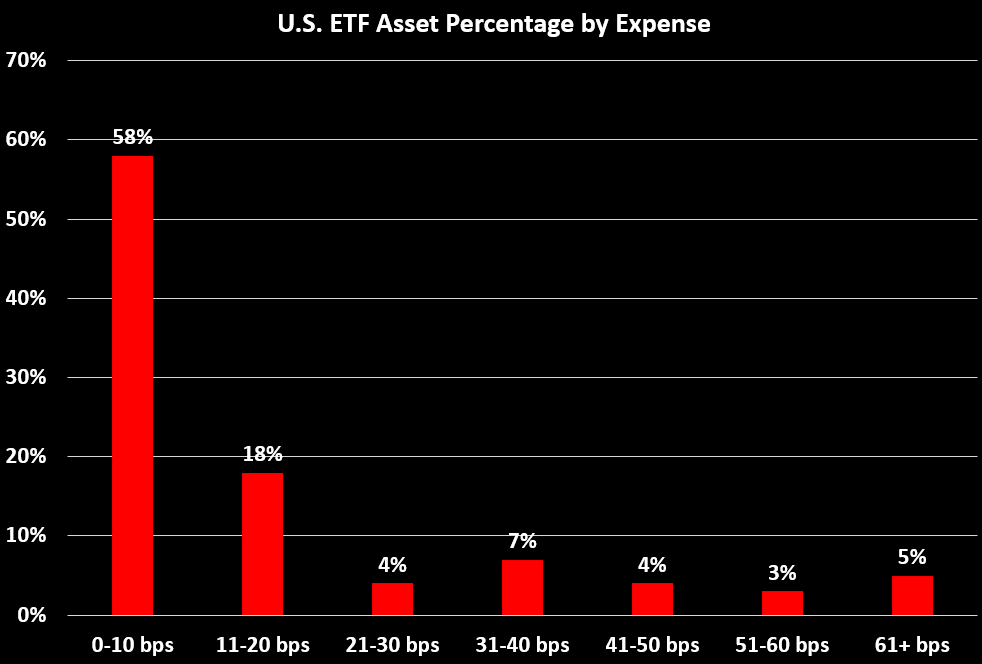
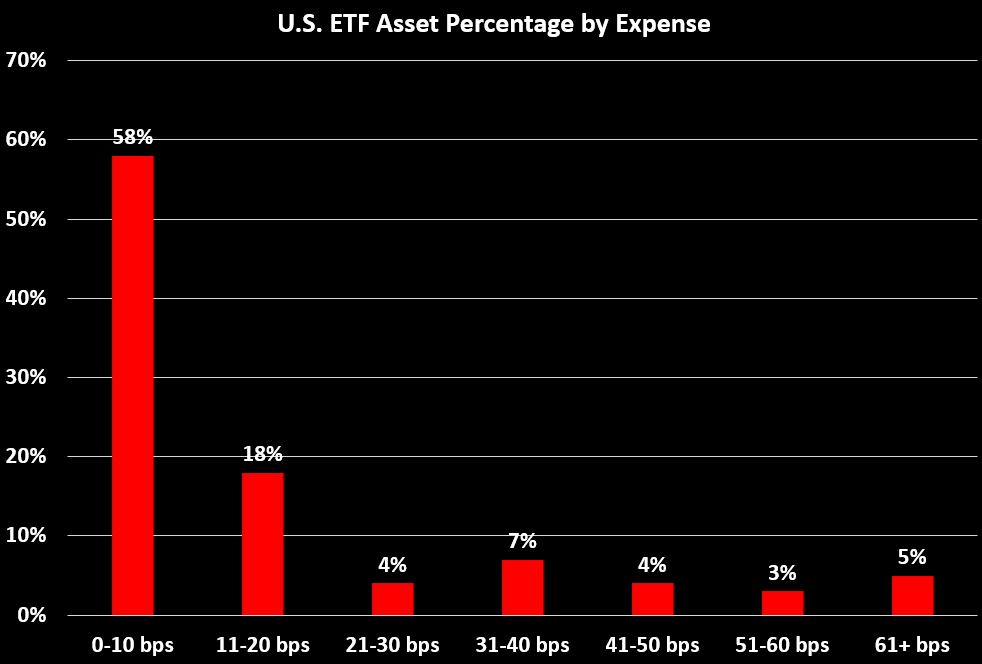
  • ETF data provided by Bloomberg points to the fact that 60% of the assets inside the $7T U.S. ETF market fall inside funds that have expense ratios under 0.10%. Over 75% of ETF assets find themselves in funds with expense ratios below 0.20%.
  • Traditionally actively managed thematic exchange traded funds typically find themselves generating expense ratios of 0.50% - 0.99%. With that being noted, the chart below shows that the overwhelming majority of ETF assets appear to be geared towards lower passively managed ETFs.
  • The SPDR S&P 500Trust ETF (NYSEARCA:SPY) is the world's largest ETF with $397.15B assets under management, and an expense ratio of 0.94%, which represents a sliver of the 58% bucket. Stocks held onto strong gains at the close of Tuesday's trading, pushing the S&P 500 back above its 200-day moving average.


Reference
Capul, J. (2022 February 15). Chart Talk: ETF assets congregate towards cheaper funds. Seeking Alpha. https://seekingalpha.com/news/3800488-chart-talk-etf-assets-congregate-towards-cheaper-funds

thanks from ifranks

AWS Amazon Web Services & Micro Focus


thanks from ifranks

Thursday

A New Hope for Managing People & Projects...

https://cdn.i-scmp.com/sites/default/files/d8/images/person/2019/07/09/image4.gif (Ye, 2019)


This discussion proposes that various levels of management can be differentiated by the roles described by Buckingham (2005), adhering to the ideals of Managing and Leading Operations (MALO) in Operations Management (OPMA). Overall, Buckingham's article is awesome!
 

Average Managers Expect Everyone To Work The Same Way, Like Stormtroopers

I tend to agree with the three analogy roles as described by Buckingham (2005), as they adequately differentiate the roles of average managers, great managers, and leaders in MALO. Regarding the ‘checkers’ analogy and average managers, it behooves all managers to outwardly treat all employees as equal, especially when directing group communications, meetings, and discussions of compensation. Quinn (2010) recognizes that managers must balance Informational, Interpersonal, and Decisional roles; in a way, I feel that it is tactically beneficial for all managers to outwardly appear as though they are ‘average managers,’ if only to convey the sense of fairness amongst their employees, especially in Mintzberg’s roles of: Disseminator, Spokesperson, Leader, Disturbance Handler, Resource Allocator, and Negotiator. Like Buckingham (2005) describes, my experience with average managers (especially those working in unionized environments) has seen little change for employees, as everyone is expected to do what they are expected to do, with very little accommodation for individual differences.


Great Managers Assemble Rag Tag Crews, Like A Rebel Alliance

In contrast, great managers may be analogous to chess players, exhibiting strengths in managing by knowing the strengths and weaknesses of each employee (or ‘chess piece’); as described by Buckingham (2005), great managers must know each employee intimately, including how to overcome weaknesses, ‘trigger’ each employee to perform well, and teach toward each employee’s preferred learning styles in order to ‘release’ the employee based on strengths. Being a great manager requires sufficient time and effort to analyze, assess, and get to know each employee, and may be easier to do with smaller groups of employees to manage, or with managers that have resources (perhaps more education and experience?) available for them to become great. Personally, I have known only a few great managers, and they have always been instrumental in ‘changing the game’ to accommodate employees, to the benefit of the organization; at the same time, employees are often reluctant to change, so a large part of a great manager’s job is to negotiate and renegotiate how people work at organizations, and change the organization itself.


Leaders Are Attuned With The Forces Of The Universe

Most leaders that I have worked with (especially in implementing Enterprise Resource Management systems) are typically concerned with the Leading and Conceptual notions of being able to see the ‘big picture’ in every facet of an organization; likewise, they must inspire their managers and employees to also see that ‘big picture’ and be motivated to achieve it over the middle- and long- term, as Buckingham (2005) describes. Good leaders possess sufficient knowledge of the Technical and Human aspects of their organization in order to motivate managers and employees, requiring the ability to quickly switch between Leading, Planning, Organizing, and Controlling (Quinn, 2010) in the face of myriad problems, ideas, and solutions.


Project Managers Are Like Jedi Masters

In my experience, I feel that project managers (PMs) must act as a hybrid combination of all the best qualities of employees, managers, and leaders, with additional skills in PM, per se. I would describe PMs as ‘chess grandmasters’ or ‘jacks-of-all-trades,’ who are good employees, great managers, and excellent leaders with enough political savvy and resourcefulness to rally everyone together for a project in the face of organizational change. (Good PMs are great at managing change, and have likely had experience working as star employees, great managers, or leaders.)
If projects have been developed and approved (as part of the allowable project portfolio structure within an organization, as described by James in 2011) to implement change, every team member’s opinions are equally important; I believe that PMs tend to treat all team members, including themselves, as equals (or perhaps like checkers pieces), in that all ideas are relevant. For the duration of a project, I envision that project team members are expected to act like managers and employees, abiding by a curious mix of bureaucratic and team structures, as depicted in the Calm Seas case (Quinn, 2010); there would be a mix of team members doing what they’re supposed to do (‘checkers’ pieces), along with dynamic ‘chess’ pieces doing what they are strong at doing, and a mix of average managers, great managers, and leaders, all coordinated by a humble project manager. I’ve observed from my work and volunteer projects that the best PMs divide their efforts between: rallying people toward project completion, knowing which people to assign to what kinds of work, and ensuring that people are able to complete their assigned work (or stepping-in to take over incomplete work).


PMs Are Different Than Other Managers & Leaders

As James (2011) describes, projects are unique one-time efforts, initiated from various departments in an organization; thus, a PM must be able to quickly familiarize themselves with the relevant stakeholders from that department and the department’s goals, while being able to negotiate (often politically) for capacity (people’s time) to take away from their regular work to invest in temporary project work. Project managers are different from project team members in their authority to make decisions, financial / resource allocations, and Execution: Estimate, Planning, and Control Activities (James, 2011). 
James (2011) recommends that PMs often use a top-down formal strategy, like Project Evaluation and Review Technique, of allotting the right managers and people to a project, including the selection of people using Project, Functional, or Matrix structures. To add control to projects, it is recommended for PMs to formally Scope a project to avoid Scope Creep (What Is, n.d.) as much as possible, which ought to keep the project life cycle shorter (perhaps based on Network Analysis), thereby respecting budgetary limits.
In practice, however, the allotment of people, scope, and budgets can be uncontrollable due to the uncharted nature of projects, and projects may often be staffed by motley crew of ‘whoever we are able to get!’ involved. Overall, anyone working as a PM should be prepared for a myriad of problems, creative solutions, and wide assortment of activities under their purview.


Going Forward 

Project managers ought to be people that are good at rallying others (leaders) to achieve a limited-time objective, while utilizing what each person can do (great management), and ensuring they do it (average management). All leaders, managers, and project managers must possess the authority to Plan, Lead, Organize, and Control (Quinn, 2010), while having the flexibility to switch to other roles as needed. MALO roles, including Conceptual, Technical, and Human (Quinn, 2010), may be more predominant in the varying types of managers / leaders, necessary for fully functional OPMA across all members of an organization, including project managers and project team members. Utilizing our MALO and OPMA knowledge, especially with good training / education, we can all be better employees, project managers, managers, and leaders.
I have met many brilliant managers, leaders, and project managers that have had informal education in these areas. I feel that enthusiasm, passion, and a positive attitude can tackle almost any challenge!  Having a more formal university education can open many more opportunities because we have a recognized and robust set of tools for exploring the world.


References

Buckingham, M. (2005) What great managers do. Harvard Business Review. https://hbr.org/2005/03/what-great-managers-do

James, T. (2011). Operations Strategy. Bookboon. https://bookboon.com/en/operations-strategy-ebook

Quinn, S. (2010). Management Basics. Bookboon.com. https://bookboon.com/en/management-basics-ebook

What Is Scope Creep in Project Management? (n.d.). Wrike Project Management Guide. https://www.wrike.com/project-management-guide/faq/what-is-scope-creep-in-project-management/

Ye, J. (2019). Auto battlers started with Dota Auto Chess and now Valve and Riot Games are joining in. [Online image]. South China Morning Post. https://cdn.i-scmp.com/sites/default/files/d8/images/person/2019/07/09/image4.gif

thanks from ifranks

Saturday

Stopping by...

The woods are lovely, dark and deep.
But I have promises to keep,
And miles to go before I sleep,
And miles to go before I sleep.
- R. Frost


Singular Future...


Processing power is likely to increase past the limits of making multiple processors smaller and vertically stacking them, known as Moore's Wall, thought to occur next year by Lilly (2016).
It appears that the notions of quantum computing, organic computers (that work like human brains), and wireless power may become 'the next big things,' even if we were to hit Moore's Wall.
 
  • Quantum Computing - it confuses most people (including the author) so perhaps we'll describe it like a magical illusion: being able to process multiple things at the same time without the appearance of doing so...?!
    Such technology may accelerate (leap!) processing power much more rapidly than Moore's Law.
  • Organic Computers - the idea of neural networks has been done before, but with a better understanding of how brains work, processors can be connected in a way that better replicates how people intuit / innovate / learn information.
    Perhaps we will invite these computers inside our brains and bodies, to improve our health.
    Perhaps these artfully intelligent computers will dream-up new ways to improve themselves!

  • Wireless Power - as science fiction author Isaac Asimov has envisioned in many of his short stories, the author believes that powering / recharging our devices will become possible over vast distances safely, without the use of wires.
    Wireless networks of energy may feed our technology...and possibly feed our bodies as well...
In total, the author humbly submits that the frightening concept of 'Singularity' (Schulze-Makuch, 2020) will occur in the next decades ahead, where technology becomes more advanced than our human brains; 
we may live in a world where technology has become more integrated with our biology than ever, such that we no longer see where humanity ends and technology begins.

Until then: "Does anyone know where I put my phone?"
 
https://thumbs-prod.si-cdn.com/SchZyPYtKv3ZROkG3SlLBVTGpQk=/800x600/filters:no_upscale()/https://public-media.si-cdn.com/filer/59/94/599497ae-18c8-4aee-a703-a921f73d8457/singularity.jpg
 
REFERENCES
Lilly, P. (2016, July 25). Moore’s Law To Hit A Wall In 2021 As Transistors Stop Shrinking, Study Says. [Article and online image]. Hot Hardware. https://hothardware.com/news/moores-law-will-hit-pothole-in-2021-transistors-stop-shrinking
Schulze-Makuch, D. (2020, March 27). Reaching the Singularity May be Humanity’s Greatest and Last Accomplishment. [Article and online image]. Air & Space. https://www.airspacemag.com/daily-planet/reaching-singularity-may-be-humanitys-greatest-and-last-accomplishment-180974528/
thanks from ifranks

Friday

Stand-Up Meetings


thanks from ifranks
Social distancing can be achieved in stand-up meetings, and motivate everyone to complete their discussions and decision making more efficiently;
the Follow-Up is essential to capture any outstanding details.
  
Here are some general guidelines from Tiffany (2018):

1. Only meet when necessary
One common employee complaint is that many meetings could easily be replaced by an email. Consider investing in a collaboration tool that facilitates ongoing conversations between team members when it’s convenient for them.

Many development teams do daily stand-ups, but you should choose a cadence that works best for your team. Try stand-ups only as needed, or have them on a weekly basis. The key is to keep them fairly short, which brings me to my next point…

2. Keep it short and sweet
At it’s core, a stand-up meeting is brief. After all, the very name implies that no one is taking the time to get comfortable. Shoot for a meeting that takes 15 minutes or less, where everyone can share necessary updates without elaborating on details.

If additional information is needed, you can always follow up afterward with an email or team chat. I love this tip from Atlassian, which recommends that if you need a sidebar during a stand-up, grab a few minutes right after the meeting. The point of a stand-up is to be quick and efficient — don’t ruin the flow by adding another meeting.

3. Establish a goal
It’s important that everyone understand why you’re having a stand-up and what’s expected of them. So many non-technical stand-ups I’ve attended have devolved into pointless updates that no one pays attention to. Talk about a waste of time.

Make sure everyone knows the goal of the stand-up so they understand what to share and how to share it. Is your goal to keep communication flowing on a project? Provide visibility into the progress of a common goal? Prioritize tasks and resources? Come to a decision and assign next steps?

The quick stand-up format works for all types of teams and situations — just be sure everyone is on the same page and stays on-track.

4. Maintain structure
A stand-up should be informal by nature, but that doesn’t mean it should be disorganized or lack focus. The meeting leader should help maintain structure and ensure no one goes off on a tangent.

Most stand-ups adhere to the following structure where everyone goes around sharing:

Progress updates
What they’re working on
Blockers and challenges
But remember, you can make a stand-up whatever you need it to be! For some teams, a task-based format works best. Instead of conducting the meeting as a “round robin” the meeting agenda covers a list of projects or tasks where individuals share updates depending on what projects they’re contributing to.

5. Make remote employees feel like they’re there
A stand-up is a great way to keep employees feeling connected and engaged. Everyone stays informed on progress and sees how each team member is contributing to the larger goal.  Don’t blow it by leaving out remote employees due to bad collaboration tools.  Here’s what you need to make sure everyone is seamlessly connected:

Video conferencing. Everyone should be able to hear and see one another. This may involve individual webcams if everyone is remote, or video conference rooms solutions for a mix of in-office and remote employees.
Screen sharing capabilities. If you need to share something on screen, it needs to be easy to display for everyone.
An easy way to join. Joining a stand-up should be hassle-free so make sure everyone has easy access to the meeting link or can join from their mobile device if they’re on the go.

6. Give everyone a chance to talk
The short nature of a stand-up meeting can make a “talking head” situation seem unavoidable. Instead, reserve a few minutes to let attendees speak, whether it’s to answer questions or update team members on the progress of their projects. No one should dominate a stand-up meeting. With the short time frame, everyone needs to share high-level or important information as concisely as possible. This isn’t the time to brag about how busy you are.

7. Don’t skip follow-up
Whether your meeting is conducted remotely, in person, while seated, or while standing, follow-up is essential. Don’t skip this important part of the process with your stand-up meetings. There are multiple ways to follow up, but the end result should be that you ensure what was discussed in the meeting moves to the next step.


Reference
Tiffany, A. (2018, February 18). 7 Rules for Effective Stand-Up Meetings. GoToMeeting.  https://blog.gotomeeting.com/7-rules-effective-stand-meetings/

Zara: Fast Fashion & Savvy Systems

REFERENCE
DH Calgary Staff. (2017, March 9). Market Mall to welcome new stores in along with more underground parking. Daily Hive. https://dailyhive.com/calgary/market-mall-new-stores-more-underground-parking-2017 

thanks from ifranks


Five Forces of Competitive Knowledge


thanks from ifranks

REFERENCE
Gallaugher, J.  (2015). Information Systems: A Manager's Guide to Harnessing Technology.  Licensed under a Creative Commons Attribution-NonCommercial-Share Alike 4.0 International License.

Thursday

CDC:NASDAQ - VictoryShares US EQ Income Enhanced Volatility Wtd ETF

The investment seeks to provide investment results that track the performance of the Nasdaq Victory US Large Cap High Dividend 100 Long/Cash Volatility Weighted Index before fees and expenses. The fund seeks to achieve its investment objective by investing, under normal market conditions, at least 80% of its assets directly or indirectly in the securities included in the Nasdaq Victory US Large Cap 100 High Dividend Long/Cash Volatility Weighted Index. The index identifies the 100 highest dividend yielding stocks in the Nasdaq Victory US Large Cap 500 Volatility Weighted Index.


thanks from ifranks

Tuesday

Contractor or Consultant?


Choose A Contractor When:

  • you have a well-defined, rock-solid plan and need more hands
  • your software won’t intersect with your larger organization now or the foreseeable future

Choose A Consultant When:

  • you need help with project definition and execution
  • you aren’t sure how external threats and opportunities will influence your choices
  • the software may live longer than anticipated
  • you want to manage the total cost of ownership directly

Reference
Do I Need A Contractor Or A Consultant? (n.d.) digital primates. Retrieved from https://www.digitalprimates.net/blog/do-i-need-a-contractor-or-a-consultant/
thanks from ifranks

Saturday

Instrumental cello & violin covers of your favorite music (Play List) ...

https://www.youtube.com/watch?v=zvcJMlIFW9A&list=PLsOmb1C5jfLPAq9h3qEiCxAO4xdnMbfew

https://www.youtube.com/watch?v=zvcJMlIFW9A&list=PLsOmb1C5jfLPAq9h3qEiCxAO4xdnMbfew

#SimplyThree

thanks from ifranks

Sometimes “Good” to “Great” Is Just a Short Step Away...


Some companies achieve highly respectable performances, while others can become unbelievable success stories. In 1996, Jim Collins and his team of 21 researchers set out to understand if good companies could subsequently become great companies. For five years, they analyzed data for almost 1,500 profitable businesses to understand what helped them transform from “good” to “great.” The book this led to–Good to Great—isn’t a collection of personal theories but rather the scientific conclusions of this study.

Humble leadership

According to the study Collins and his team carried out, leaders who are able to transform their companies into extraordinary enterprises are those who have a combination of personal modesty and professional ambition. They are able to keep their egos in check to serve the greater good of the business. Collins noted that executives who carry too much personal ambition generally prevent good companies from transitioning into excellent ones. On an everyday level, this means taking full responsibility when there is a problem, without blaming others or the circumstances. Good leaders generally attribute their achievements to luck, while others only take credit for their accomplishments.
“Executives who carry too much personal ambition generally prevent good companies from transitioning into excellent ones”

First who, then what

The process of transforming a company into an extremely profitable one begins with the choice of who to bring on board to work with—which should come well before the step that consists of deciding what to do. Collins observed that, in many mid-size operations, bosses are seen as sacred guides and everyone around them is simply there to help them achieve their goal. But the study shows that it is shrewder to bring together a tight team who will be able to propose competent solutions to problems than to impose a master plan on everyone. Leaders owe it to themselves to follow this rule, which also means removing people who do not have adequate skills.
In general, this recommendation applies to managers as well as to entrepreneurs. We are often tempted to concentrate on one idea and then build a team afterward around the goal. However, Collins found that doing the process in reverse was more effective.
“It is shrewder to bring together a tight team who will be able to propose competent solutions to problems than to impose a master plan on everyone”

Confronting reality

During their research, Collins and his team found that the most important task for this type of transformation in a company is taking on the problems the business is dealing with in a totally transparent and candid manner. So what doesn’t work well in the company and its organization? What needs to improve before obstacles can be overcome? When faced with these questions, managers and company heads need to instill a climate of confidence so that the employees can become part of the conversation and bring their thoughts and ideas to the table. This can be achieved by doing different things in the workplace, such as making time to get together and talk things over once a week or once a month, installing a suggestion box, setting up the means to make internal communication easier and checking in on a regular basis.
“The most important task for this type of transformation in a company is taking on the problems the business is dealing with in a totally transparent and candid manner”
Collins uses the example of Procter & Gamble’s arrival on the consumer-goods market in the 1960s. Faced with the success of a new competitor, Kimberly-Clark admitted that Procter & Gamble’s products were better than theirs, and they used this as a catalyst for change. By accepting the harsh reality that their brands had been outdone by the competition, the teams at Kimberly-Clark were able to turn this into motivation to become stronger and take the market back from Procter & Gamble. If company leaders can accept that they are “behind the eight ball,” they will be able to unite their teams in hard times and emerge as the winners. There is no point in hiding the truth from employees, even when things are not pretty.
“If company leaders can accept that they are ‘behind the eight ball,’ they will be able to unite their teams in hard times and emerge as the winners”

The hedgehog concept and the culture of discipline

Collins also points out the difference between the ambition you can have for your company and the understanding of what actually makes it an effective company. Thus, the most crucial element for becoming great is objectively targeting the sector in which the company could become the best, the most profitable, and the most passionate in the world. The researchers found that it is more effective to concentrate on one goal at a time, just as a hedgehog does. The underlying parable in the book is that although a fox knows many ways to hunt a hedgehog, the hedgehog successfully concentrates on just one thing: Defending itself.
Using this as a starting point, the best approach is to install rigorous discipline in the company so that does not find it has spread itself too thinly. The most successful businesses are those that learn to do fewer things at one time, whereas less-successful ones tend to live under the constant fear of missing out on an opportunity.
“The most successful companies are those that learn to do fewer things at one time”

Using technology

In his research, Collins observed that mediocre companies were likely to idolize technology and rely on it. On the other hand, companies that were able to cross the gap from good to great only used technology to accelerate their success and not to create everything from scratch. Eighty percent of the executives interviewed about the transformation process of their companies didn’t mention technology as being a factor, even in the case of pioneering companies such as Nucor—an American steel-products company that reorganized its priorities in the late 1960s and became the number one in the US several years later.
“Mediocre companies were likely to idolize technology and rely on it”
On the whole, we tend to think that we will perform better if we have every gadget going, or that the company would achieve better results if it has a digital platform or services that use cutting-edge technology. Collins helps us understand that this is not always the key to success and that we should not be fooled by this illusion.

Climbing the steps one by one

During the five years that Collins and his team worked on their study, they established that the companies that were unsuccessful in making the transition from good to great generally tried to climb too many steps at once and, as a consequence, had disappointing results. Collins saw that most of the companies were not aware of their transition, did not broadcast it, and did not concentrate on one key decision, grand action plan, or groundbreaking innovation. Success comes down to accepting that it is a process that takes a certain amount of time and is only observable in retrospect.
“Success comes down to accepting that it is a process that takes a certain amount of time and is only observable in retrospect”
Collins illustrates this point using the American pharmaceutical company Warner-Lambert as an example, a direct competitor of Gillette in the 1960s. Each time a new CEO took the helm at Warner-Lambert, they would come in with a new action plan that put the brakes on the one that had previously been put in place. If the new strategy was not seen to be working better than the previous one quickly enough, the CEO would be shown the door without anyone really taking the time to understand the underlying reasons. After a great deal of restructuring, and what Collins describes as a downward spiral, the company disappeared at the end of the 1990s, a victim of its inability to be patient and put things into perspective.
“In wanting to move too fast, we sometimes miss out on potential success”
As the head or manager of a business, it is tempting to want immediate results. Collins’s book helps us understand that in wanting to move too fast, we sometimes miss out on potential success. It is important to accept that economic timescales impose certain lapses of time between the actions carried out and the achievement of the anticipated effects.
Collins has updated his bestseller, first published in 2001, several times. He has sold more than three million copies, and it is considered one of the best management guides on how good can become great.
Follow Welcome to the Jungle on Facebook to see our articles in your timeline every day!
Photograph by WTTJ
Translated by Mary Wagonner-Moritz


Reference

Dancette, A. (2019, May 20). Sometimes “Good” to “Great” Is Just a Short Step Away. [Article and online image]. Welcome to the Jungle. Retrieved from https://www.welcometothejungle.com/en/articles/sometimes-good-to-great-is-just-a-short-step-away

thanks from ifranks

More...