
Cheers to the Calgary Chamber of Volunteer Organizations for their support of this partnership!


Thank you to Adriana, Willow, Tim, Shawn, Joel, Joe, Richard, and Frank.


“Google is big. Very big. Its millions of servers process about 1 petabyte of user-generated data every [60 minutes]...bigness is the very point of Google...its competitive advantage-is its ability to find meaning in massive sets of data. The larger the data sets, the more potential meaning can be derived...”By the by, one petabyte (PiB) is equal to 1,125,899,906,842,624 bytes (B), and each standard byte contains eight bits (ones and/or zeros). Impressive, isn’t it?

“...because Microsoft is a follower, there is a concern that it could use its Windows monopoly to restrict choices”
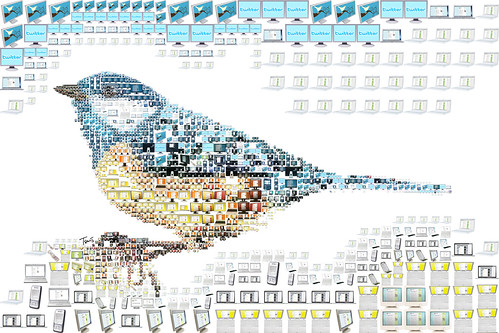
Note that back then, the Twitter service was only 600 days old – this is a reflection of the significantly swift adoption rate that y'all have for web services that “just work” connect you with your friends and family.“When China’s Sichuan Province suffered its horrendous earthquake in May 2008, people who felt it firsthand shared their experience via Twitter...people in the quake zone would use Twitter to update friends...If I were going through a quake, I’d want to tell family and friends that I was safe, wouldn’t you?”
“...those of us that teach students in rapidly changing arenas...must get better at keeping up with – no, getting ahead of – our students, industry, and society.”

How do some of the newer, smaller, web vendors that "give away" free online services pay their employees, though?
The Web 2.0 conundrum...
Any brilliant ideas about this?


“Google is big. Very big. Its millions of servers process about 1 petabyte of user-generated data every [60 minutes]...bigness is the very point of Google...its competitive advantage-is its ability to find meaning in massive sets of data. The larger the data sets, the more potential meaning can be derived...”By the by, one petabyte (PiB) is equal to 1,125,899,906,842,624 bytes (B), and each standard byte contains eight bits (ones and/or zeros). Impressive, isn’t it?
“...because Microsoft is a follower, there is a concern that it could use its Windows monopoly to restrict choices”
Note that back then, the Twitter service was only 600 days old – this is a reflection of the significantly swift adoption rate that y'all have for web services that “just work” connect you with your friends and family. What Would Google Do?:“When China’s Sichuan Province suffered its horrendous earthquake in May 2008, people who felt it firsthand shared their experience via Twitter...people in the quake zone would use Twitter to update friends...If I were going through a quake, I’d want to tell family and friends that I was safe, wouldn’t you?”
“...those of us that teach students in rapidly changing arenas...must get better at keeping up with – no, getting ahead of – our students, industry, and society.”
We're enjoying the multitudes of free web applications that are being developed nowadays to "just work," with the software vendor getting out of the way.
How do some of the newer, smaller, web vendors that "give away" free online services pay their employees, though? The Web 2.0 conundrum... Any brilliant ideas about this?

This book is an "easy read," and the first half contains very keen insights about how to improve profits (across industries) today through Google.
After reading about the future of sales, I considered how experiential marketing, brand awareness, and advertising is becoming a more essential part of the Google world. I mean, how would anyone know what to type in the search box without marketing?The latter chapters have some proposed models for the way the world might work in the future, and I noted how formal training, education, and continuing education is already changing into a more self-taught "Google" paradigm. Today, education is still a hot commodity - I think it can be kept "hot" with some of the following ideas, for starters:
Oh, while you're at it, have a look at the Popular Search terms box on the top left of my blog. Pretty nifty, eh?

This book is an "easy read," and the first half contains very keen insights about how to improve profits (across industries) today through Google.
After reading about the future of sales, I considered how experiential marketing, brand awareness, and advertising is becoming a more essential part of the Google world. I mean, how would anyone know what to type in the search box without marketing?The latter chapters have some proposed models for the way the world might work in the future, and I noted how formal training, education, and continuing education is already changing into a more self-taught "Google" paradigm. Today, education is still a hot commodity - I think it can be kept "hot" with some of the following ideas, for starters:
Oh, while you're at it, have a look at the Popular Search terms box on the top left of my blog. Pretty nifty, eh?


